Intelligent Defect Recognition in Pipeline MFL In-Line Inspection
Oct 9, 2026
·
2 min read
Research / Area 5
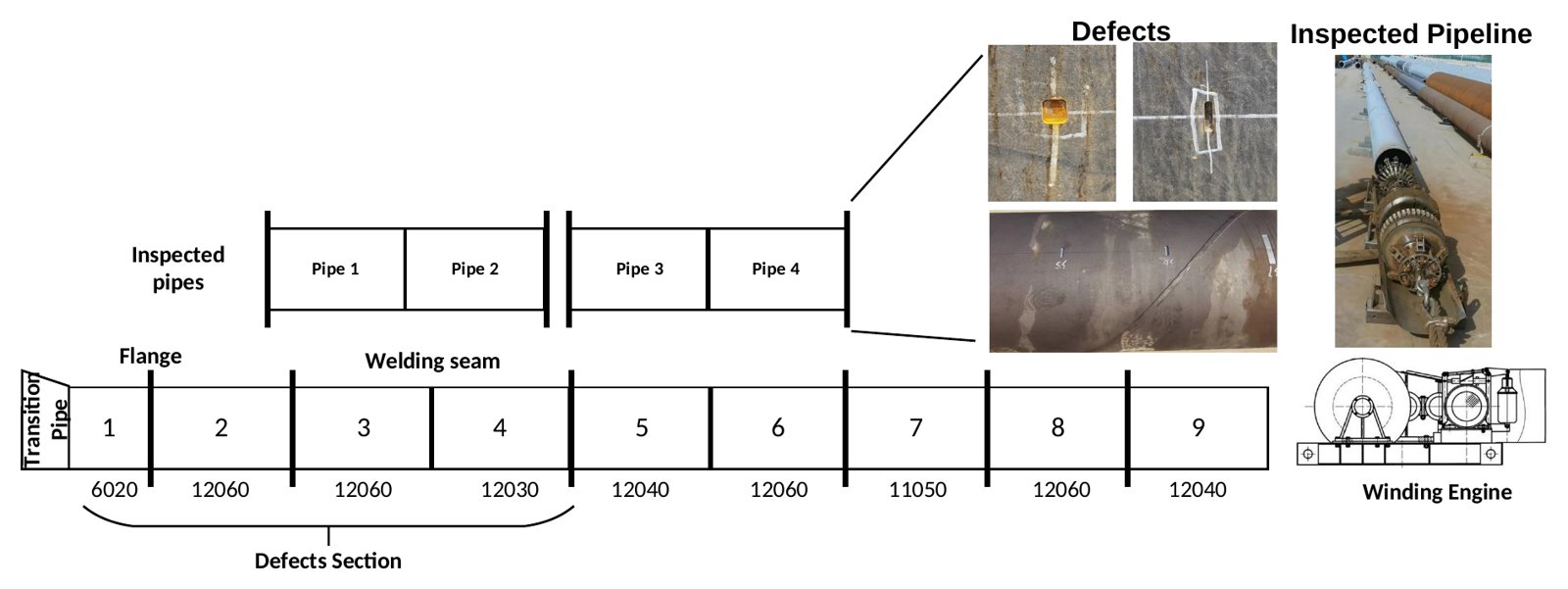
Magnetic flux leakage (MFL) in-line inspection is the main method for detecting corrosion and cracks in long-distance pipelines. One run produces massive signal data, while defect samples with excavation labels are scarce.
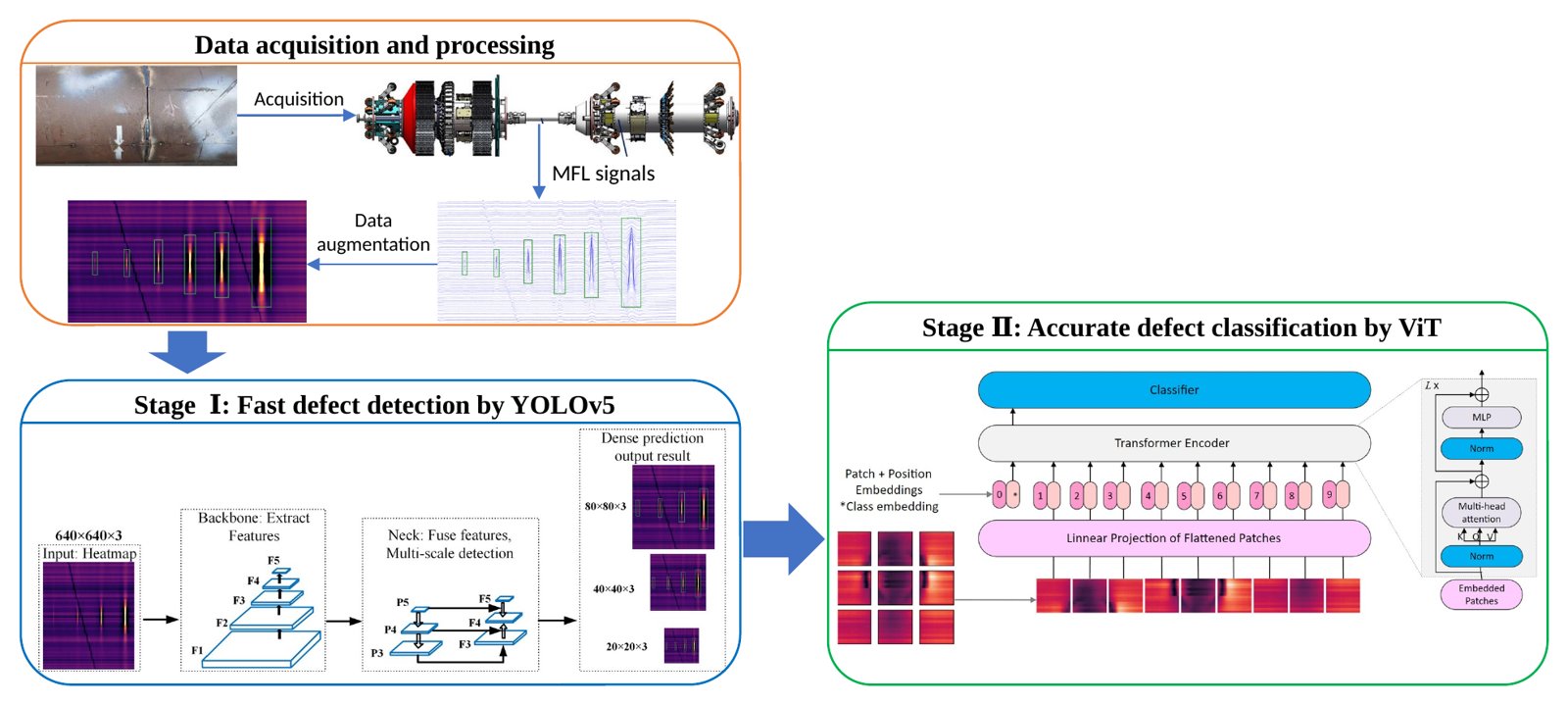
With Prof. Jianli Wang’s group at Southeast University, the group proposes cascaded deep learning: a pretrained YOLO network locates defects on MFL images, then a Vision Transformer or multi-input parallel CNN regresses defect length, width and depth. Diffusion models generate samples and reconstruct under-sampled signals.
Representative papers
- J Xie, J Yang, K Fu, L Tai, X Wang, J Zhu, J Wang. Quantitative Assessment of Pipeline Defects Utilizing a Dual-Stage Deep Learning Framework: Integration of Pretrained YOLO Network and Multi-input Parallel Convolution …. Journal of Pipeline Science and Engineering, 100282, 2025.
- J Yang, Y Zhang, C Su, K Fu, J Zhu, J Wang. Multi-Priors Tensor Completion for Highly Under-sampled Magnetic Flux Leakage Signal Reconstruction. Journal of Pipeline Science and Engineering, 100382, 2025.
- J Yang, J Xie, X Gao, K Fu, J Zhu, J Wang. Synthetic Magnetic Flux Leakage Signal Generation Using Diffusion Models: A Novel Approach to Improve Pipeline Defect Detection Accuracy. Journal of Pipeline Science and Engineering, 100363, 2025.
- X Chen, M Fu, X Liu, J Zhu. Synthesizing Labeled Magnetic Flux Leakage Signals for Pipeline Integrity Assessment: A Generation and Evaluation Methodology. IEEE Transactions on Instrumentation and Measurement, 2025.
- P Chen, R Li, K Fu, Z Zhong, J Xie, J Wang, J Zhu. A cascaded deep learning approach for detecting pipeline defects via pretrained YOLOv5 and ViT models based on MFL data. Mechanical Systems and Signal Processing 206, 110919, 2024.